US Employee Monitoring Compliance Guide (2026)
Employee monitoring is generally permitted under US federal law when conducted for legitimate business purposes and in compliance with applicable state laws. However, the regulatory landscape is complex. With specific state-level notice requirements emerging nationwide, how and where you store tracking data is critical. This guide provides a general overview of baseline rules and explains why considering on-premise deployment may help organizations reduce third-party data risks.
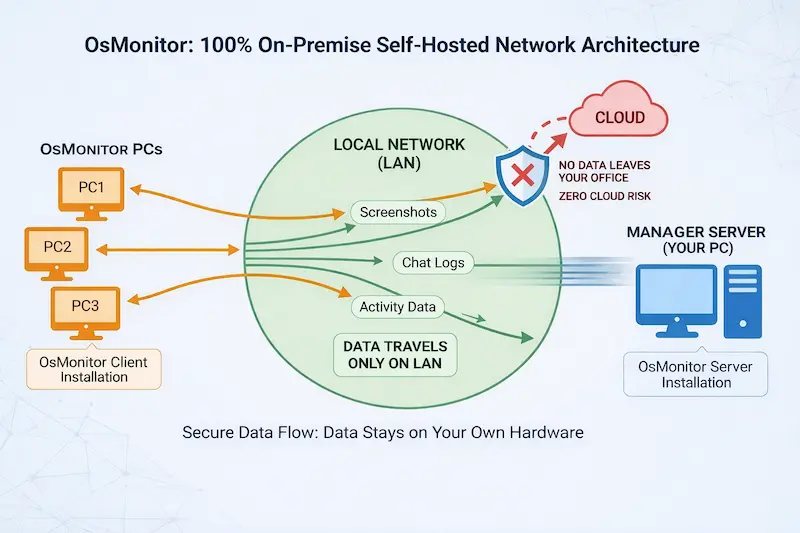
Compliance starts with data control: Keep your employee tracking data strictly on your own local servers.
The Baseline Rules: Federal vs. State Considerations
To responsibly track a workforce in the United States, employers typically navigate two levels of legislation:
🏛️ Federal Law (The ECPA): The Electronic Communications Privacy Act (ECPA) generally permits employers to monitor computer usage if there is a legitimate "business exception" or if the employee has given consent.
📍 State-Level "Notice" Requirements: States like New York, Delaware, and Connecticut have implemented specific laws mandating explicit, written notice to employees prior to electronic monitoring.
🚫 The Privacy Boundary: Employers generally should not monitor personal devices (BYOD) without explicit consent, and must avoid monitoring employees in areas where there is a "reasonable expectation of privacy."
Selected States with Specific Notice Requirements
Different states have vastly different requirements regarding employee notification. Below is a summary of key states with specific legislation highlighting the varied nature of these laws:
| State | Specific Notice Law? | Written Notice? |
|---|---|---|
| New York | Yes | Yes (Mandatory) |
| Delaware | Yes | Yes (Mandatory) |
| Connecticut | Yes | Yes (Mandatory) |
The Cloud SaaS Consideration: Managing Vendor Risks
Using third-party cloud monitoring services may introduce additional compliance, security, and vendor-management obligations, particularly in regulated industries such as healthcare and finance. If a third-party monitoring vendor suffers a data breach, your organization may face regulatory, contractual, or reputational consequences. By choosing on-premise Windows employee monitoring, organizations keep their data strictly isolated on their own secure local network.
| Infrastructure Factor | OsMonitor (On-Premise) | Cloud SaaS Tools |
|---|---|---|
| Data Ownership | Managed locally by your internal team. | Stored by a third-party vendor. |
| Third-Party Exposure | Minimized. Data remains on LAN. | Subject to vendor security practices. |
How OsMonitor Supports Compliance Programs
Rather than providing legal guidance, OsMonitor focuses on delivering technical features that empower organizations to execute their own internal compliance policies securely and effectively:
- 🛡️ On-Premise Architecture: By keeping all data strictly on your local network, organizations significantly reduce third-party cloud exposure and simplify vendor risk assessments.
- 👁️ Flexible Visibility Modes: Configure the software to run silently or display a visible system tray icon, aligning with organizational transparency goals or specific state notice requirements.
- ⌨️ No Keystroke Logging: Intentionally omitting keylogging features helps mitigate the risk of inadvertently collecting highly sensitive personal data, such as private passwords or payment credentials.
- 🔐 Access Management: Centralized controls ensure that only authorized administrative or HR personnel can review collected activity logs.
Frequently Asked Questions
Q: Does OsMonitor support transparent monitoring, and does it log keystrokes?
OsMonitor is adaptable to various organizational policies. It supports both stealth and transparent (visible icon) modes. Crucially, OsMonitor does not include keystroke logging functionality, helping organizations reduce the risk of collecting sensitive personal information such as passwords or payment credentials.
Q: Can employers monitor employees working from home?
Monitoring of company-issued devices is often treated differently from monitoring personal devices, but requirements vary by jurisdiction and workplace policy. Monitoring personal devices (BYOD) used for remote work typically requires explicit, documented consent from the employee.
Q: Is stealth monitoring legal in the US?
Stealth monitoring may be permitted in some jurisdictions when used on company-owned equipment and supported by appropriate workplace policies. Requirements vary significantly by state and circumstance. Employers should review applicable state laws and seek legal advice when necessary.
Q: How does OsMonitor assist with regulated industry compliance?
Using third-party cloud monitoring services may introduce additional compliance and vendor-management obligations. OsMonitor is completely on-premise, allowing your internal IT team to secure sensitive records behind your own corporate firewall.
Official Legal Sources & Authoritative References
- Electronic Communications Privacy Act of 1986 (ECPA) - US Bureau of Justice Assistance
- New York Civil Rights Law §52-c (Notice of Electronic Monitoring) - NY State Senate
- Delaware Code Title 19 § 705 (Notice of monitoring of communications)
- Connecticut General Statutes §31-48d - CT General Assembly
- The Security Rule - U.S. Department of Health & Human Services (HHS)
Secure Your Local Network
Consider an on-premise monitoring solution to maintain control over your organizational data infrastructure.