EU Employee Monitoring & GDPR Compliance Guide (2026)
Navigating employee monitoring within the European Union requires strict adherence to the General Data Protection Regulation (GDPR). Unlike jurisdictions where employer ownership of equipment implies broad monitoring rights, the GDPR prioritizes the fundamental privacy rights of the individual. This guide explores the core principles of EU workplace privacy and explains how utilizing on-premise monitoring architecture can assist organizations with data sovereignty and internal compliance controls.
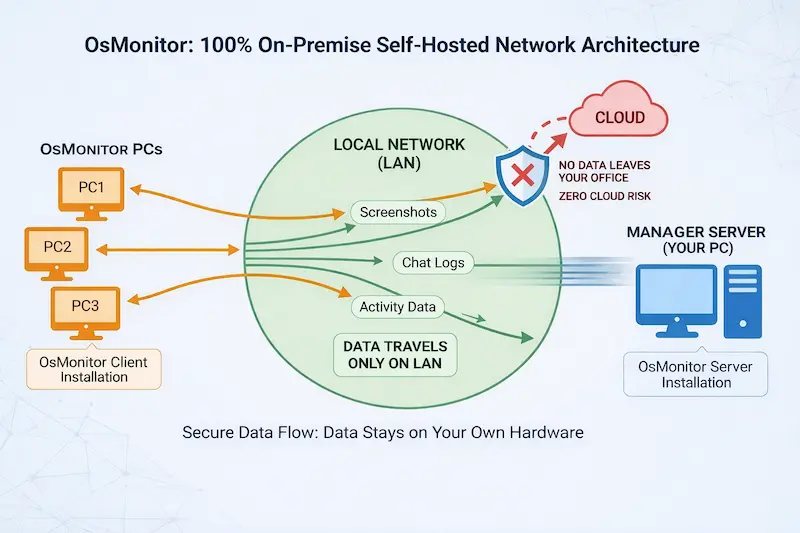
Compliance starts with data sovereignty: Keep EU employee tracking data strictly on your own local servers.
The GDPR Baseline: Key Principles for Employers
Under the GDPR, deploying software to monitor employee activity is considered "processing of personal data." Organizations typically must address several foundational requirements:
⚖️ Legal Basis (Article 6): Employers rarely rely on "consent" because employees cannot freely refuse. Monitoring is usually justified under "Legitimate Interest," provided the employer's need to protect business assets outweighs the employee's privacy rights.
📢 Transparency (Article 13): Employees must be explicitly informed about the nature, scope, and purpose of the monitoring before it begins. Clear, accessible privacy policies are strongly recommended.
📋 Data Protection Impact Assessment (DPIA): Before implementing systematic monitoring of employees, organizations are generally required to conduct a DPIA (Article 35) to evaluate necessity, proportionality, and risks.
The Cloud SaaS Risk: Cross-Border Transfers & Schrems II
One of the most significant challenges for EU employers is managing where monitoring data is stored. Using third-party SaaS monitoring tools hosted outside the European Economic Area (EEA)—such as cloud servers in the US—introduces complex compliance burdens regarding international data transfers. By choosing on-premise employee monitoring solutions, organizations can retain 100% of their data within their own physical offices, thereby avoiding third-party vendor risks and simplifying GDPR data sovereignty requirements.
| Compliance Factor | OsMonitor (On-Premise) | Cloud SaaS Tools |
|---|---|---|
| Data Sovereignty | Data never leaves your local EEA network. | Data stored on remote, third-party servers. |
| Third-Party Processors | None. You act as the sole data controller. | Requires Data Processing Agreements (DPA). |
How OsMonitor Can Assist Compliance Controls
OsMonitor provides technical features designed to empower EU organizations to execute their internal data protection policies effectively:
- 🛡️ Local Data Processing (Article 32): By operating purely on-premise, organizations drastically reduce the risk surfaces associated with cloud breaches and third-party vulnerabilities.
- 👁️ Transparent Visibility Options (Article 13): Employers can configure the software to display a visible system tray icon, supporting the obligation to inform employees that monitoring systems are active.
- ⌨️ Data Minimization (Article 5): OsMonitor purposely omits keystroke logging functionality. This architectural decision helps prevent the excessive collection of sensitive, non-work-related data (such as private communications or bank details).
- 🔐 Access & Retention Management: Administrators can tightly control who has access to monitoring records within the internal LAN, supporting data confidentiality requirements.
Frequently Asked Questions
Q: How does OsMonitor help us comply with GDPR requirements?
OsMonitor equips your organization with the robust technical controls needed to support your GDPR goals—such as 100% localized data sovereignty, data minimization protocols, and transparent mode configurations. When integrated with your company's internal data protection policies and DPO guidelines, it forms a secure foundation for compliant workplace management.
Q: Is employee monitoring legal under the GDPR?
Employee monitoring is not prohibited under the GDPR, but it is subject to strict conditions. Monitoring is generally based on "legitimate interest" and must be proportionate, transparent, and preceded by a Data Protection Impact Assessment (DPIA).
Q: Is stealth monitoring permitted in the European Union?
Secret or stealth monitoring is highly restricted under the GDPR. Employees have a fundamental right to be informed about how their data is processed. Stealth monitoring is generally only considered in highly exceptional circumstances, such as specific, legally justified criminal investigations, and typically requires prior consultation with legal authorities.
Q: Why is on-premise deployment advantageous for EU compliance?
On-premise deployment allows organizations to store monitoring logs directly on their internal local networks. This helps employers maintain strict data sovereignty, avoiding the complex legal obligations and risks associated with transferring EU employee data to third-party cloud vendors.