Australia Employee Monitoring Compliance Guide (2026)
Employee monitoring in Australia is governed by a complex intersection of the federal Privacy Act 1988 and specific state-based workplace surveillance legislation. With regulatory scrutiny intensifying over third-party data breaches, Australian employers are increasingly prioritizing internal data control. This guide outlines baseline regulatory considerations and explains how on-premise computer monitoring software can assist organizations in retaining data sovereignty and managing compliance risks.
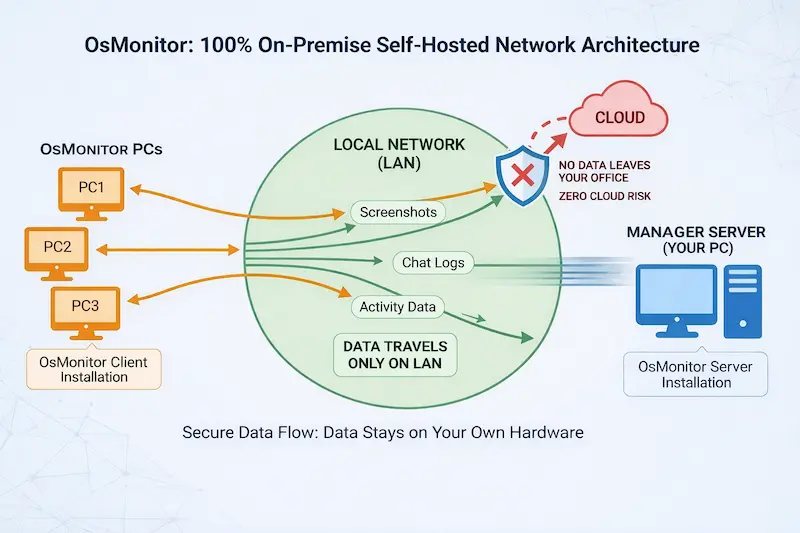
Mitigate third-party risks: Keep internal tracking records securely within your corporate network in Australia.
State Surveillance Laws vs. Federal Privacy Guidelines
Unlike many regions with unified national frameworks, Australian employers must navigate strict state and territory laws governing the actual implementation of employee tracking software:
📢 Explicit Notification (State Level): Jurisdictions such as New South Wales (NSW Workplace Surveillance Act) and the ACT mandate explicit, written notice to employees prior to commencing computer monitoring (e.g., often a 14-day prior notice period). The notice must clarify what is being monitored, how, and when.
🚫 Covert Monitoring Restrictions: Across most Australian states, secretly monitoring employees without notice is prohibited unless an employer obtains a specific covert surveillance authority (typically a magistrate's order) for investigations into unlawful conduct.
⚖️ The Privacy Act & Data Security: While the federal Privacy Act contains an "employee records exemption," organizations are still heavily scrutinized regarding how securely they store corporate and personal data, especially in light of recent high-profile cyber incidents.
The Cloud SaaS Risk: Third-Party Breach Vulnerabilities
Following severe national cyberattacks on major telecom and healthcare providers, Australian businesses face immense pressure to secure their supply chains. Exporting PC monitoring software logs (which may contain sensitive screen captures or internal communications) to third-party cloud vendors introduces massive vendor-management risks. Opting for an on-premise deployment allows companies to retain 100% of their data within their own physical borders, drastically reducing exposure to external SaaS vulnerabilities.
| Security Factor | OsMonitor (On-Premise) | Cloud SaaS Solutions |
|---|---|---|
| Data Sovereignty | Data never leaves your Australian internal network. | Data may be hosted on offshore third-party servers. |
| Supply Chain Risk | Minimized. You act as the sole data custodian. | High reliance on external vendor security postures. |
How OsMonitor Assists with Organizational Controls
OsMonitor functions as a technical platform designed to provide granular configuration, empowering Australian IT managers to align deployments with their state-specific workplace policies:
- 🛡️ LAN-Restricted Storage: Centralizes logs securely on your own local machines, mitigating the risk of external cloud breaches.
- 👁️ Transparent Deployment Modes: Administrators can configure the software to display a visible system tray icon, technically supporting internal policies designed to meet state notification requirements.
- ⌨️ No Keystroke Logging: To support data minimization, OsMonitor intentionally avoids keylogging functions, assisting organizations in preventing the unnecessary collection of sensitive private passwords.
- 🔐 Role-Based Access: Restricts data review privileges to designated corporate leadership or authorized HR personnel via local console access.
Frequently Asked Questions
Q: How does OsMonitor help us comply with Australian privacy laws?
OsMonitor equips your organization with the powerful technical controls needed to support your privacy goals—such as 100% on-premise data localization, flexible transparency settings, and the omission of keylogging. When combined with your proper internal HR policies and state-mandated employee notices, OsMonitor forms the secure foundation of your compliant monitoring strategy.
Q: Are employers legally allowed to monitor computers in Australia?
Workplace monitoring is generally permitted, but it is heavily regulated by state and territory laws. In jurisdictions like New South Wales (NSW) and the Australian Capital Territory (ACT), employers must provide explicit, written prior notice to employees before commencing computer surveillance.
Q: Is stealth monitoring legal in Australia?
Covert or stealth monitoring without prior notice is highly restricted in many Australian states. It is typically only permitted with a specialized covert surveillance authority (such as a magistrate's warrant) for specific investigations involving suspected unlawful activity.
Q: How does on-premise software reduce compliance risks in Australia?
Following significant national data breaches, Australian organizations face intense scrutiny over third-party data handlers. On-premise software ensures that employee tracking logs remain exclusively within the local corporate network, mitigating the severe regulatory and reputational risks associated with third-party cloud SaaS vulnerabilities.