Turkey Employee Monitoring & KVKK Compliance Guide (2026)
Organizations operating in Turkey must carefully navigate the Personal Data Protection Law (KVKK - Kişisel Verilerin Korunması Kanunu) when deploying employee monitoring software. The Turkish regulatory environment is particularly stringent regarding cross-border data transfers and employer transparency. This guide outlines fundamental considerations and explains how on-premise computer monitoring software can assist Turkish employers in maintaining strict data localization and internal compliance.
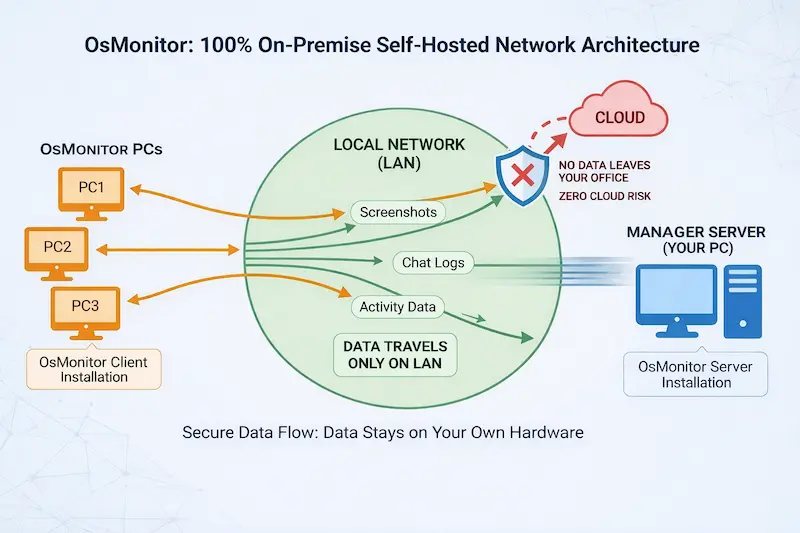
Compliance starts with localization: Keep internal tracking records securely within your corporate network in Turkey.
Core Pillars of KVKK in the Workplace
Under the KVKK framework, tracking an employee's digital activity constitutes the processing of personal data. Employers typically must align with several critical mandates:
⚖️ Obligation to Inform (Aydınlatma Yükümlülüğü): Employers cannot monitor staff secretly as a standard practice. Before deploying any employee tracking system, companies must provide a clear "Clarification Text" explaining what data is collected, the legal basis, and its purpose.
📍 Data Localization (Article 9 Constraints): Transferring personal data abroad without explicit consent or adequate protection safeguards is heavily restricted by the Personal Data Protection Board (KVKK Kurulu). This makes using foreign cloud services particularly challenging for Turkish businesses.
📋 Proportionality & Purpose Limitation: The monitoring must be directly related to and necessary for a legitimate business objective. Over-collection of data, especially sensitive personal data, is strictly scrutinized.
The Cloud SaaS Risk: Why Local Deployment is Preferred
For organizations in Turkey, relying on third-party SaaS cloud tools hosted in Europe or the US introduces significant legal friction due to KVKK Article 9 restrictions. If a foreign vendor processes your PC monitoring software logs, you may face complex legal hurdles or potential regulatory penalties for unauthorized data transfers. Opting for an on-premise deployment allows companies to retain 100% of their data within their own physical borders, assisting in risk mitigation regarding cross-border transfers.
| Infrastructure Factor | OsMonitor (On-Premise) | Cloud SaaS Solutions |
|---|---|---|
| Data Localization | Data never leaves your local network in Turkey. | Data is often hosted on foreign cloud servers. |
| Article 9 Friction | Bypassed. You act as the sole internal controller. | Requires complex legal commitments and approvals. |
How OsMonitor Can Assist Internal Compliance Controls
OsMonitor functions as a technical platform designed to provide granular configuration, empowering Turkish IT managers to adapt tracking deployments to their internal KVKK strategies:
- 🛡️ LAN-Restricted Storage: Centralizes logs securely on your own local machines, supporting the critical requirement of data localization.
- 👁️ Transparent Deployment: Administrators can configure the software to display a visible system tray icon, aligning with internal policies enforcing the obligation to inform.
- ⌨️ No Keystroke Logging: To support the KVKK principle of data minimization, OsMonitor intentionally avoids keylogging functions, assisting organizations in preventing the collection of highly sensitive personal passwords or banking details.
- 🔐 Role-Based Access: Restricts data review privileges to designated corporate leadership or authorized HR personnel via local console access.
Frequently Asked Questions
Q: How does OsMonitor support our KVKK compliance strategies in Turkey?
OsMonitor provides the comprehensive technical infrastructure to support your KVKK strategies—including strict data localization, adjustable visibility modes, and data minimization controls. When combined with your organization's formal Clarification Text (Aydınlatma Metni), it assists in building a reliable internal compliance environment.
Q: How does KVKK affect employee monitoring software?
Under the KVKK, employers must have a valid legal basis to monitor employees. While explicit consent is one basis, employers often rely on "legitimate interest" provided that the monitoring is strictly proportionate to business protection and employees are fully informed beforehand.
Q: Why is on-premise software important for KVKK compliance?
Article 9 of the KVKK imposes exceptionally strict rules on transferring personal data outside of Turkey. Utilizing an on-premise solution keeps tracking data within the local corporate network, assisting organizations in bypassing the complex legal hurdles associated with foreign cloud servers.
Q: Is stealth monitoring permitted under Turkish law?
Stealth monitoring is highly legally risky under the KVKK. Employers are generally required to fulfill their obligation to inform employees prior to processing their data. Secret monitoring may only be considered in extremely rare, legally justifiable circumstances, requiring consultation with legal experts.