UK Employee Monitoring & Privacy Compliance Guide (2026)
Implementing workplace oversight within the United Kingdom requires clear alignment with the UK GDPR and the Data Protection Act 2018 (DPA 2018). Guided by the Information Commissioner's Office (ICO), UK framework dictates that worker surveillance must respect the core tenets of transparency and balance. This guide outlines baseline regulatory considerations and explains how deploying employee monitoring software via an on-premise model can assist organizations with internal privacy controls and risk management.
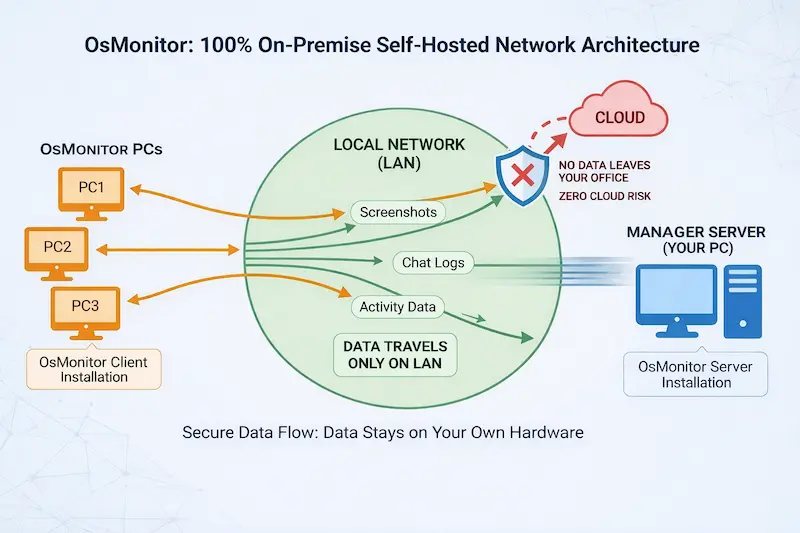
Compliance starts with data localization: Keep your internal user tracking records safely behind your own corporate firewall.
Core Pillars of UK Workplace Data Protection
Under the regulatory oversight of the ICO, any digital tracking is defined as the processing of workforce personal data, demanding strict adherence to these foundational expectations:
⚖️ The Proportionality Test: Employers must demonstrate that the business risk they seek to prevent justifies the level of monitoring involved. Intrusive methods should be avoided if less invasive means can achieve the same organizational goal.
📢 Prior Transparency: Secretly monitoring workers is highly restricted. Except in narrow, legally justified investigations involving suspected criminal activity, staff must be clearly informed about what is being tracked, why, and how the logs are used.
📋 Data Protection Impact Assessments (DPIA): The ICO strongly expects or mandates employers to complete a formal DPIA before implementing tracking workflows that pose high risks to employee privacy rights.
The Cloud SaaS Risk: Data Transfers & Vendor Governance
Utilizing third-party cloud SaaS tracking tools often means exporting sensitive employee screen captures, communications, and behavioral logs to external servers located outside the UK. If a third-party monitoring vendor experiences a security compromise, your organization may face regulatory consequences. Opting for on-premise Windows employee monitoring software allows UK companies to isolate all tracking logs locally. This strategy may assist with maintaining data control and mitigating complex compliance risks tied to cross-border transfers.
| Governance Factor | OsMonitor (On-Premise) | Cloud SaaS Solutions |
|---|---|---|
| Data Jurisdiction | Kept strictly within your internal UK network. | Subject to foreign server hosting rules. |
| Processor Overheads | Minimized. You operate as the sole controller. | Requires continuous third-party risk audits. |
How OsMonitor Can Assist Internal Compliance Controls
OsMonitor functions as a technical platform designed to provide granular configuration, empowering UK IT managers and employers to adapt tracking deployments to their own internal compliance baselines:
- 🛡️ LAN-Restricted Storage: Centralizes logs on your own local machines, keeping tracking activity shielded from external environments.
- 👁️ Granular Visibility Management: Allows administrative selection between hidden operation or transparent icon deployment, supporting the company's employee disclosure policies.
- ⌨️ No Keystroke Logging: To support the principle of data minimization, OsMonitor intentionally avoids keylogging functions, helping protect sensitive personal credentials.
- 🔐 Role-Based Access: Restricts data review privileges to designated compliance officers or corporate leadership via secure localized console access.
Frequently Asked Questions
Q: How does OsMonitor help us comply with UK data protection laws?
OsMonitor equips your organization with the necessary technical safeguards to support your UK GDPR initiatives—such as local data isolation, flexible transparency settings, and the omission of keylogging. Combined with your proper internal workplace policies and DPIAs, OsMonitor establishes a secure architecture for internal data governance.
Q: Is employee monitoring lawful under UK data protection laws?
Workplace monitoring is not prohibited under UK GDPR or the Data Protection Act 2018, but it must satisfy strict lawful processing conditions. Monitoring is generally based on "legitimate interest" and must be proportionate, transparent, and preceded by a Data Protection Impact Assessment (DPIA).
Q: Can UK employers monitor remote workers or staff working from home?
Monitoring of company-issued devices is often treated differently from monitoring personal devices, but requirements vary based on workplace policy. Under ICO guidelines, monitoring remote workers typically requires the same level of transparency and proportionality as on-site staff, and cross-border data transfer risks must be carefully evaluated if cloud tools are utilized.
Q: How does OsMonitor support the ICO principle of data minimization?
OsMonitor can assist with internal compliance controls by offering on-premise data localization and purposely omitting keystroke logging. This technical architectural decision helps organizations reduce the risk of collecting excessive personal data, such as private credentials or banking details.